UX Strategy
Design Systems
The MyRedVest Orders App is the mobile-first replacement for Lowe's legacy Sterling desktop — enabling store associates to find, claim, pick, stage, and fulfill Pick-Up-In-Store orders entirely on Zebra TC-series handheld devices. I joined as the UI/UX designer on the Cosmic Coders agile team, designing the North Star experience from early wireframes through dev-ready specifications.

One handheld workflow. One unified mobile experience.
Lowe's legacy Sterling system was built for desktop, then forced onto a 4-inch Zebra TC51 screen with no adaptation. Store associates fulfilling Pick-Up-In-Store orders had no way to claim an order, no visibility into fulfillment type, and no unified view across three separate systems, Sterling, Genesis, and .com, costing them 14 minutes per order in workarounds, paper tickets, and duplicate work.
As the Product Designer embedded on the agile project team, I owned the mobile UX from initial store immersion through dev-ready specifications, mapping the Claiming, Escalation, Pick, Stage, and Fulfill journey, designing wireframes and visual specs in Sketch, and staying one sprint ahead of development throughout the build.
14 min
efficiency savings per
order picked, sustained
through redesign
4+
fulfillment flows designed
— PUIS, Curbside,
Parcel, Truck Delivery
3
order systems unified —
Sterling, Genesis, and
.com
0
paper tickets — fully
digital pick, stage, and
fulfill workflow
The Problem
Associates were losing 14 minutes per order to a broken desktop-first workflow on a handheld device.
The legacy Sterling system was never designed for mobile. Associates picking PUIS orders on Zebra TC51 devices had no claiming system, no fulfillment type visibility, and no way to handle curbside or multi-system orders without switching apps. The MyRedVest Orders App redesign unified the experience — from order search through fulfillment — entirely on the device.
A desktop-first order system forced onto a 4-inch handheld — with no claiming, no unified orders, and no mobile-native UX.
What the legacy experience was missing
What the new app needed to solve
The Approach
Sprint-by-sprint design — always one ahead of development.
Embedded on the Cosmic Coders agile team, I drove the mobile UX from initial discovery to dev-ready specifications — attending grooming sessions, running design shares, and staying one sprint ahead of development throughout.
01
Design Sprint + Store Immersion & Discovery: Spent a full week moderating a design sprint followed by a a full week embedded in Lowe's stores observing associates completing PUIS orders on Zebra devices. Documented pain points in the Pick > Stage > Fulfill flow — including duplicate pick issues, missing staging locations, and the friction of switching between Sterling and Genesis. Research findings directly informed the feature prioritization and interaction model for the redesign.
02
Journey Mapping & Flow Design: Collaborated with the Product Owner to map the full PUIS master journey — from order creation through curbside or in-store fulfillment. Produced high-level journey flows, task-based scenario flows, and interaction flows for engineering handoff covering Claiming, Escalation, Pick, Stage, and Fulfill.
03
Wireframes & Iterative Design: Produced wireframes and visual design specifications in Sketch for Order Inquiry (Search & Results), Order Details, Item Details, and the Open Orders claiming list — iterating each screen through multiple grooming sessions, Design Shares, and Store Ops reviews. All designs published and tracked in Abstract.
04
North Star Component Application: Applied Lowe's North Star design system and Material Design components throughout — including the App Bar, FAB, Bottom Sheet search, Tabs, Cards, and Notification system. Worked closely with the lead engineer to ensure component usage aligned with the platform's approved patterns and dev constraints.
05
Dev Handoff & UAT: Produced dev-ready visual design specifications (VzD) in Abstract collections for each feature sprint — with annotated interaction flows, redline specs, and icon documentation. Worked directly with development teams to validate implementation against design intent. Pattern reviews and approvals completed one sprint ahead of execution.
Discovery: Mapping Current And Future State
Design sprint + store immersion before screen design.
Before any wireframe was drawn, I spent a full week moderating a design sprint followed by a full week embedded in Lowe's stores observing associates completing PUIS orders on Zebra TC51 devices — surfacing the gap between how the product team assumed associates worked and how they actually worked.
01
Design Sprint + Store Immersion & Contextual Observation: Observed associates across the full Pick > Stage > Fulfill flow in live store conditions. Documented pain points firsthand — duplicate pick collisions, missing staging locations, and the friction of context-switching between Sterling and Genesis mid-order. Every friction point observed in the field was directly mapped to a design requirement.
02
Current-State Documentation: Catalogued the legacy Sterling mobile experience screen-by-screen: flat order lists with no status differentiation, manual number entry on a 4-inch keyboard, desktop-weight data density on a handheld display, and zero notification capability for time-sensitive SLA thresholds.
03
Future-State Journey Mapping: Collaborated with the Product Owner, PMs, and designers to map the full PUIS master journey — from order creation through curbside or in-store fulfillment. Produced high-level journey flows, task-based scenario flows, and interaction flows for engineering handoff covering Claiming, Escalation, Pick, Stage, and Fulfill..


Interaction Flows
Three core flows that defined the mobile ordering experience.
The interaction model was built around the three critical paths associates encounter on every order — mapped
end-to-end across associate, system, and customer swim lanes before a single screen was designed.
01 - Order Inquiry — Search and Search Results Flow
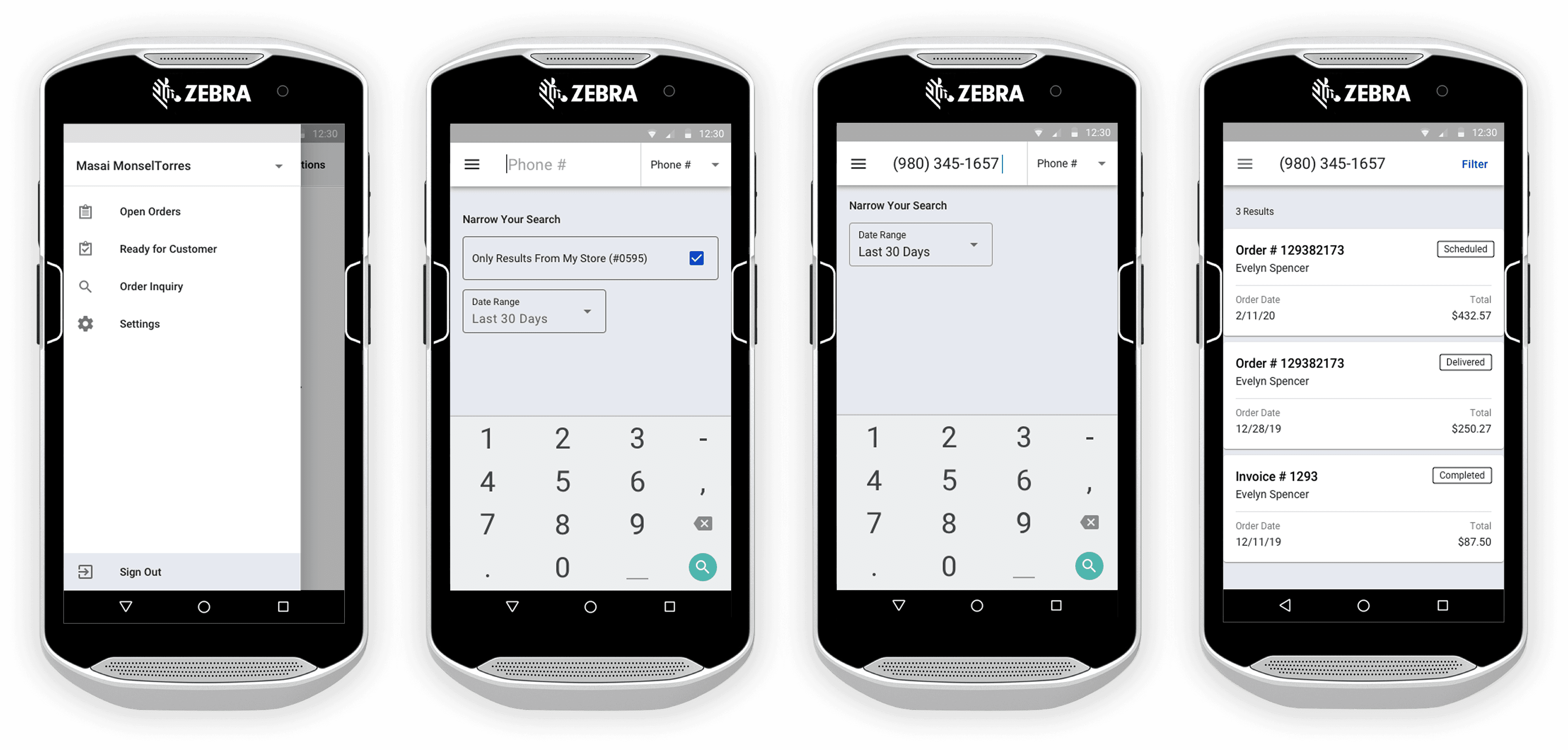
A customer calls the store to ask about an order. The associate opens the MyRedVest Orders App, selects Order Inquiry, and searches by phone number — locating the order and answering the customer's question entirely on the Zebra device without switching systems.

02 - Pickup in Store: Claiming, Picking and Staging
A customer purchases a stock item on Lowes.com and wants to pick it up in store. This flow covers both the Happy Path (all items available) and Short Pick (partially fulfilled) scenarios — from associate claiming the order through pick, stage, and customer fulfillment.

03 - Pickup in Store: Curbside Pickup
A customer purchases a vacuum on Lowes.com and wants curbside pickup. The associate picks and stages the order, is notified when the customer is en route, brings items to the Curbside Pickup Area, and completes fulfillment on the device — no paper, no system switching.

The Solution
A unified mobile-native fulfillment experience built on North Star.
The MyRedVest Orders App replaced the legacy Sterling desktop experience with a purpose-built mobile workflow
across three core interaction flows — each designed screen-by-screen in Sketch and delivered as dev-ready
VzD specifications in Abstract.
WIREFRAMES
From flows to screens — iterating toward North Star.
With the interaction model validated, I translated each flow into screen-by-screen wireframes in Sketch —
iterating through grooming sessions, Design Shares, and Store Ops reviews before moving to visual design.

01 Order Inquiry — Wireframes
The Open Orders list defaulted to unclaimed-first sort with a persistent barcode scan entry point at the top — eliminating manual number entry. A bottom-sheet search pattern kept the app bar and list context intact when searching manually.

02 Claiming, Picking and Staging — Wireframes
Unclaimed/Claimed status badges with unclaimed-first sort directly eliminated the duplicate pick problem observed during store immersion. A three-status model (In Progress / Completed / Canceled) replaced the
matrix of system-specific legacy statuses across Sterling, Genesis, and .com.
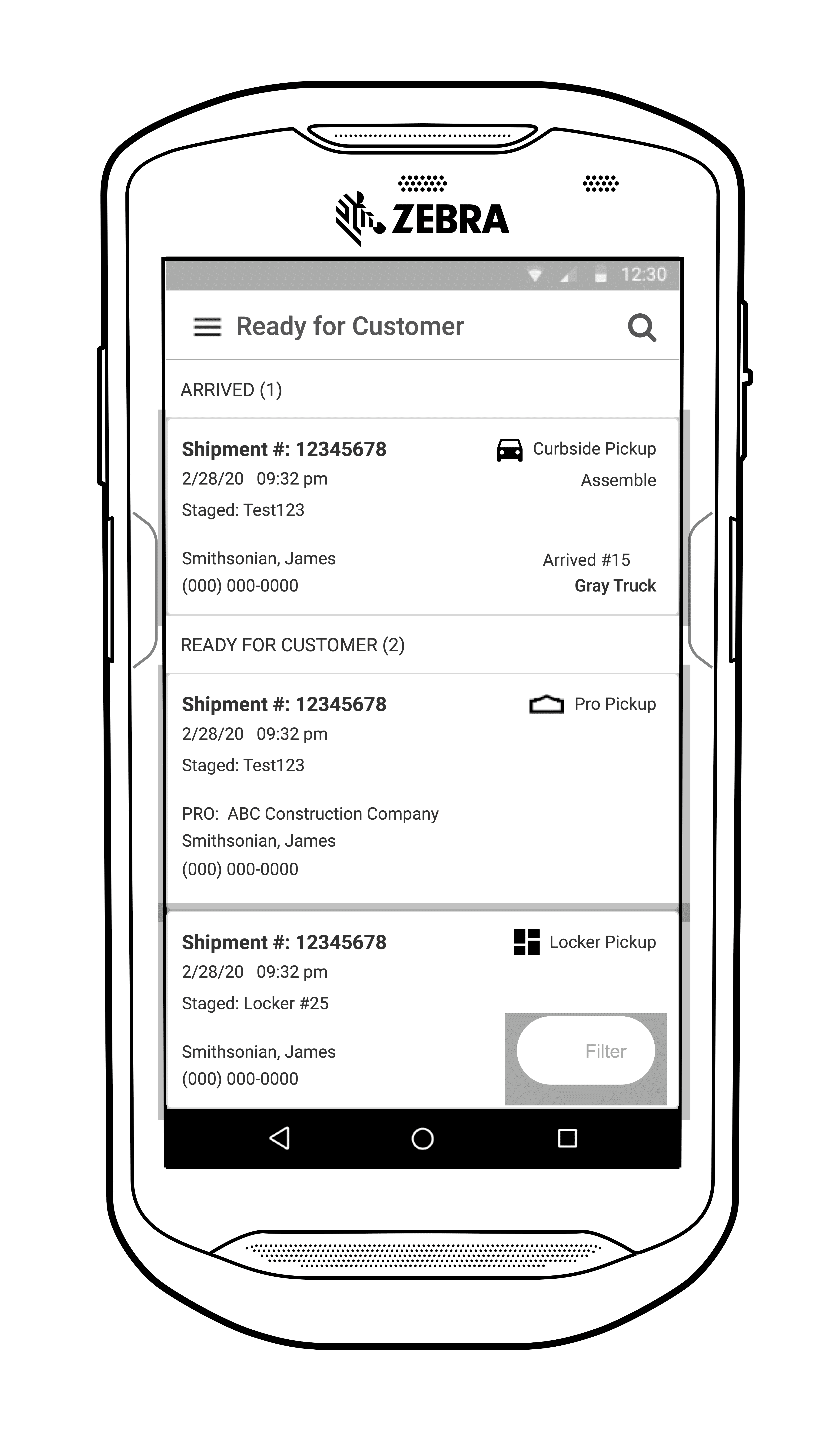
03 Curbside Pickup — Wireframes
Associates receive push notification when the customer is en route, move items to the Curbside Pickup Area, and complete the entire fulfillment transaction on the Zebra device including eSignature — no paper, no system switching.
Selected Work — Final Design
BEFORE & AFTER
From legacy Sterling list to North Star — claiming, fulfillment types, and real-time notifications.

BEFORE — Legacy Sterling (Open Orders)

AFTER — North Star Redesign (Open Orders)
SEARCH
Order Inquiry — Search Order type dropdown, barcode entry, search field

ORDER DETAILS
Order Details Tabbed layout: Order Info, Items, Delivery, Comments
ITEM DETAILS
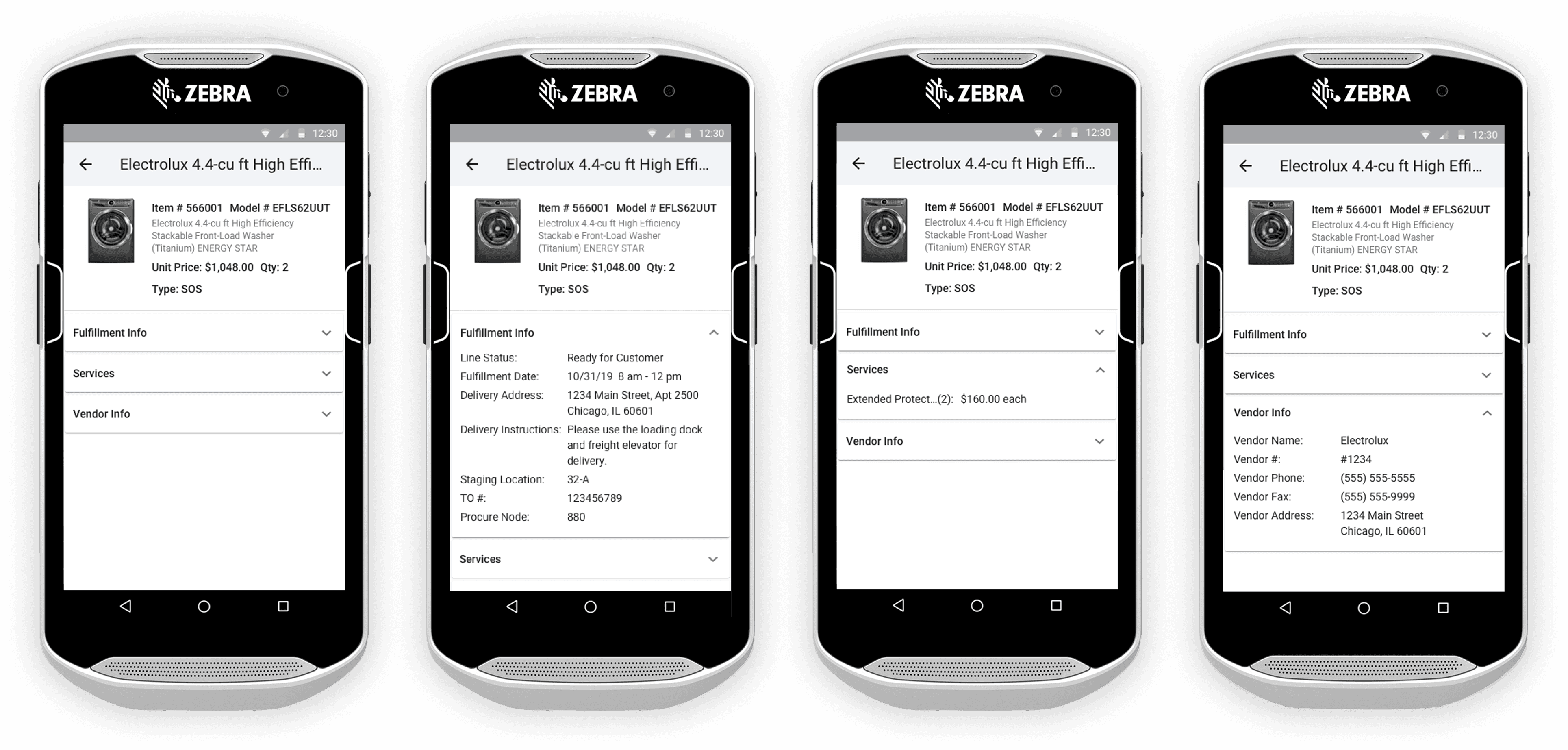
Item Details Product thumbnail, fulfillment info, line-level status
The Impact
A mobile-first order fulfillment experience that put the right information in the right hands — at the right moment.
Designed the end-to-end UX for Lowe's MyRedVest Orders App mobile — a B2E enterprise tool used by store associates nationwide on Zebra handheld devices to fulfill Pick-Up-In-Store orders. Delivered journey flows, wireframes, and dev-ready Sketch specifications across Search & Results, Order Details, Item Details, Claiming & Escalation, and Pick/Stage/Fulfill. The North Star-compliant redesign sustained the 14-minute-per-order efficiency savings target across all fulfillment types — PUIS, Curbside, Parcel, and Truck Delivery — with zero paper tickets in the workflow.
14 min
efficiency savings per
order picked, sustained
through redesign
4+
fulfillment flows designed
— PUIS, Curbside,
Parcel, Truck Delivery
3
order systems unified —
Sterling, Genesis, and
.com
0
paper tickets — fully
digital pick, stage, and
fulfill workflow
Field research before screen design
A week embedded in stores before drawing a single screen meant every design decision was grounded in how associates actually worked — not how product teams assumed they worked.
Unifying three systems into one mental model
The single highest-impact decision was the simplified three-status model (In-Progress / Completed / Canceled) that worked across Sterling, Genesis, and .com — reducing cognitive load at the moment of lookup.
Claiming eliminated duplicate work
The introduction of a claiming system with Unclaimed First sort order directly addressed the duplicate pick problem associates reported daily — a fix grounded entirely in store immersion findings.
Design one sprint ahead enables shipping
Staying one sprint ahead of Dev & QA — with all reviews and approvals complete before the sprint began — was the key operational pattern that kept the team shipping consistently throughout Q2 2020.