Design Systems
UI / UX Design
44,570+
Client risk-improvement actions enabled platform-wide in 2022
6
IoT technologies and frameworks unified under one design system
2,000+
Loss prevention engineers globally using new DCE tools
The year I was at FM Global was defined by two parallel and deeply interconnected initiatives. The first was Polaris: a suite of apps — some for clients, some for Field Engineers — accessible as individual dashboards within a single unified portal. The second was the Resilience design system: a from-scratch overhaul of FM Global's brand identity and digital assets that would underpin every surface of the new platform. My mandate across both was clear — apply new Digital Brand Standards to bridge the gaps in the customer journey and achieve design coherence across platforms.
4
product workstreams designed concurrently across the Polaris ecosystem
2
primary user groups served — FM Global clients and Field Engineers
4
device contexts designed for — desktop, tablet, smartphone, and mobile app
1
unified design system (Resilience) powering all Polaris product surfaces

The Problem
Two legacy products. One replacement platform. No design coherence to build from.
In 2021, FM Global announced the discontinuation of MyRisk and Visit Planner — its core risk management and optimization products for clients. The replacement was Polaris: a new Digital Client Experience platform built from the ground up, drawing from a variety of IoT technologies and frameworks to present a suite of apps to the user via tabs as individual dashboards.
What the organization was facing
MyRisk and Visit Planner reaching end-of-life with no clear successor experience defined
No unified design language or component system to build from Multiple product teams building in parallel without shared standards
A client experience that needed to serve both external clients and internal Field Engineers within one platform
Brand identity that hadn't been overhauled to reflect the company's digital ambitions
What the design work needed to achieve
A unified design system (Resilience) that could scale across the full Polaris ecosystem
Figma specifications defining the UX for both FE and client-facing platform surfaces
Design coherence across all apps, dashboards, and device contexts
Bridging gaps in the customer journey left by the legacy MyRisk and Visit Planner transition
A build-and-launch process including QA, UAT, and compliance validation
Resilience Design System – The design foundation that made the platform possible.
Before the Polaris product surfaces could achieve coherence, FM Global's Experience Design team needed to build the system that would underpin them. The Resilience project was a complete overhaul of the company's brand identity and digital assets — establishing the shared language that every product team could build from. My role was to apply those new Digital Brand Standards across each Polaris workstream in real time — translating system-level decisions into product-level specifications that development partners could implement consistently.
Brand Identity Overhaul
Complete refresh of FM Global's digital brand — color, typography, iconography, and visual language — rebuilt for a modern platform context.
Reusable Component Architecture
A shared library of Figma components and interaction patterns that could scale across six product surfaces and four device contexts without drift.
Digital Brand Standards
Documented standards ensuring design coherence across platforms — from the Polaris portal shell to individual app dashboards and responsive breakpoints.
Cross-Team Design Alignment
A shared foundation that allowed parallel product teams to build independently without producing a fragmented end-user experience.
The Overview – One portal. A suite of apps. Two user types. Built in parallel.
The Polaris platform was designed as a single portal giving users access to a suite of interconnected apps — some serving FM Global's external clients, others serving internal Field Engineers. Each app was accessible as its own tabbed dashboard within the portal. I created Figma design specifications defining the user experience for Field Engineers and FM Global clients across the following key platform workstreams.
Polaris DCE Platform Shell
The responsive core portal — a B2B PaaS for insurance, risk management, and employee productivity — housing and connecting all Polaris modules via unified navigation.
Digitally Enabled Field Visit
The replatform of MyVisit and Horizon — the core pre-visit, during-visit, and post-visit workflow for Field Engineers, with guided data collection and codified OR/OS.
Aerial Imagery & Map View
A new mapping platform providing location-level visual intelligence to
engineers and clients before and during site visits..
Climate Change Impact Report
A data visualization dashboard surfacing climate impact and long-term risk trends at client locations — designed for both engineers and executive client users.
Virtual Fire Scenario Tool
A responsive B2B fire visualization tool enabling engineers to model and present real-time risk scenarios to clients during and after site visits.
Enterprise & Location Risk Insite
FM Global's staple risk improvement and recommendations tools — rebuilt with new design standards for both executive client dashboards and engineer-level reporting.
The Approach
Designing across six product surfaces while building the system beneath them.
My day-to-day spanned reviewing features with project teams, designing product experiences in Figma, conducting research with customers, and presenting design concepts to designers and product partners — across multiple concurrent workstreams, all anchored to the Resilience design system being built in parallel.
01
Project Initiation & Requirements Translation: During initial sprints, I worked closely with each product team to translate business requirements into fully realized feature components — grounding design decisions in the platform vision of a unified, modular ecosystem rather than designing each app in isolation.
02
Discovery — Research, Competitors & Best Practices: During discovery phases, I researched competitors and industry best practices across enterprise risk platforms, IoT dashboards, and B2B PaaS products, regularly sharing findings with each project team. Customer research was conducted to validate design directions and uncover unmet needs across both Field Engineer and FM Global client user groups.
03
Concept Design — Proof of Concepts Across All Device Contexts: I developed initial proof-of-concept explorations for all four Polaris product modules — the DCE Platform shell, the Virtual Fire Scenario Tool, the Climate Change Impact Report, and Enterprise Risk Insite — across tablet, desktop, smartphone, and mobile app screen contexts. Each exploration translated the product vision into a candidate interaction model grounded in the emerging Resilience design standards.
04
Detailed Design — Figma Prototypes & Usability Testing: I created interactive Figma prototypes across the Polaris and Virtual Fire Scenario Tool workstreams, conducting usability testing of proposed interface designs with customers to validate decisions before moving into development. Approved designs for the Climate Change Impact Report, Enterprise Risk Insite, and Virtual Fire Scenario Tool were delivered with full Figma specifications for development partners.
05
Build, QA & User Acceptance Testing: I QA tested the new platform within the technical environment — validating finished components for compliance with business rules and design specifications before deployment. User Acceptance Testing ensured the implemented experience matched the approved design intent across all Polaris surfaces and device contexts, closing the gap between design and the live product.
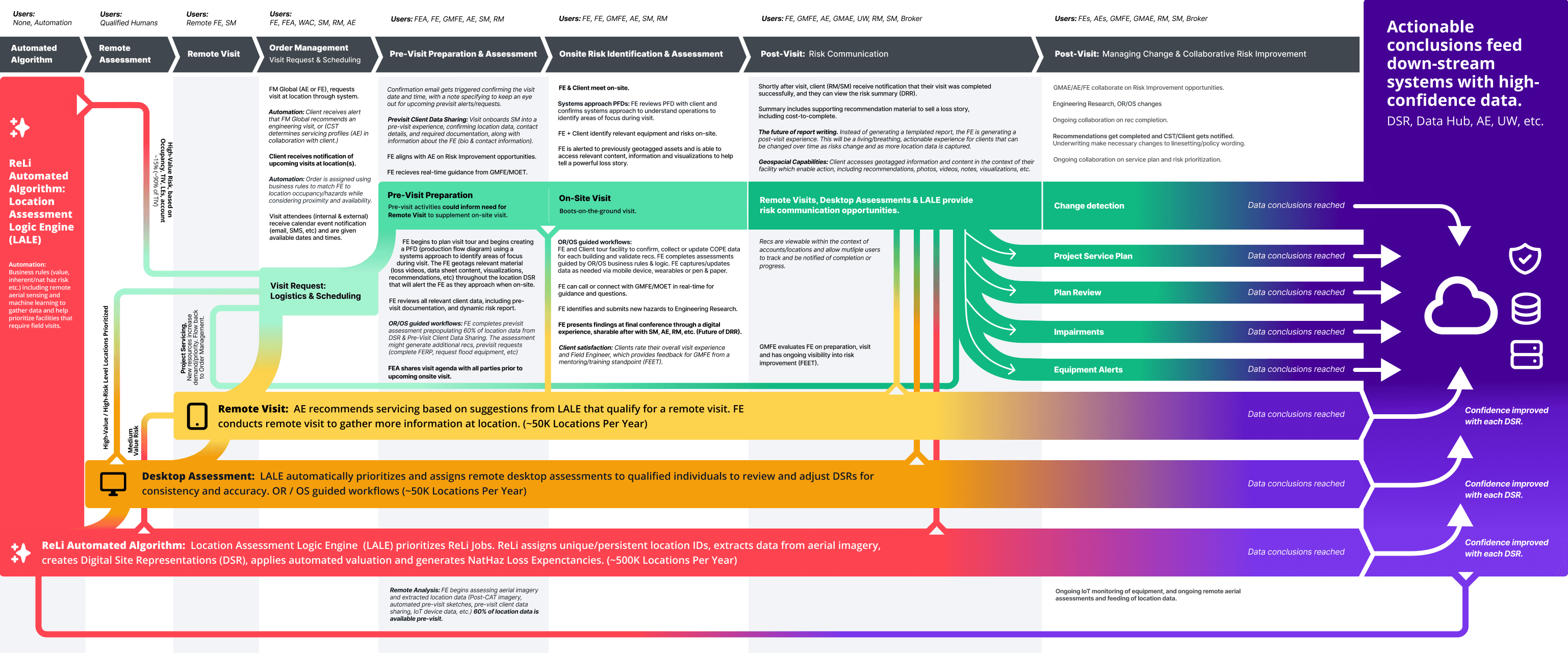
Field Engineer workflow — three phases designed end-to-end
PRE-VISIT
Order assignment & scheduling notifications
Desktop Assessment with codified OR/OS guidance
Data prepopulation from prior DSR assessments
Guided workflow & risk review preparation
VISIT
Dynamic COPE data collection on tablet
Real-time exposure calculations (LE, MFL)
Fire simulation and visual risk tools in session
Call-a-specialist and remote guidance features
POST-VISIT
Partially automated report pre-populated from visit data
Streamlined review & report publishing tools
Remote stakeholder final conference capability
Downstream data system integration
MGMT. OF CHANGE
Live location data view post-recommendation
Client-facing risk improvement planning
Ongoing impairment & project tracking
Continuous engineering mindset support
The Continuous Engineering Journey
Polaris DCE Platform | Explorations

Assignments Home
EARLY wireframe concept
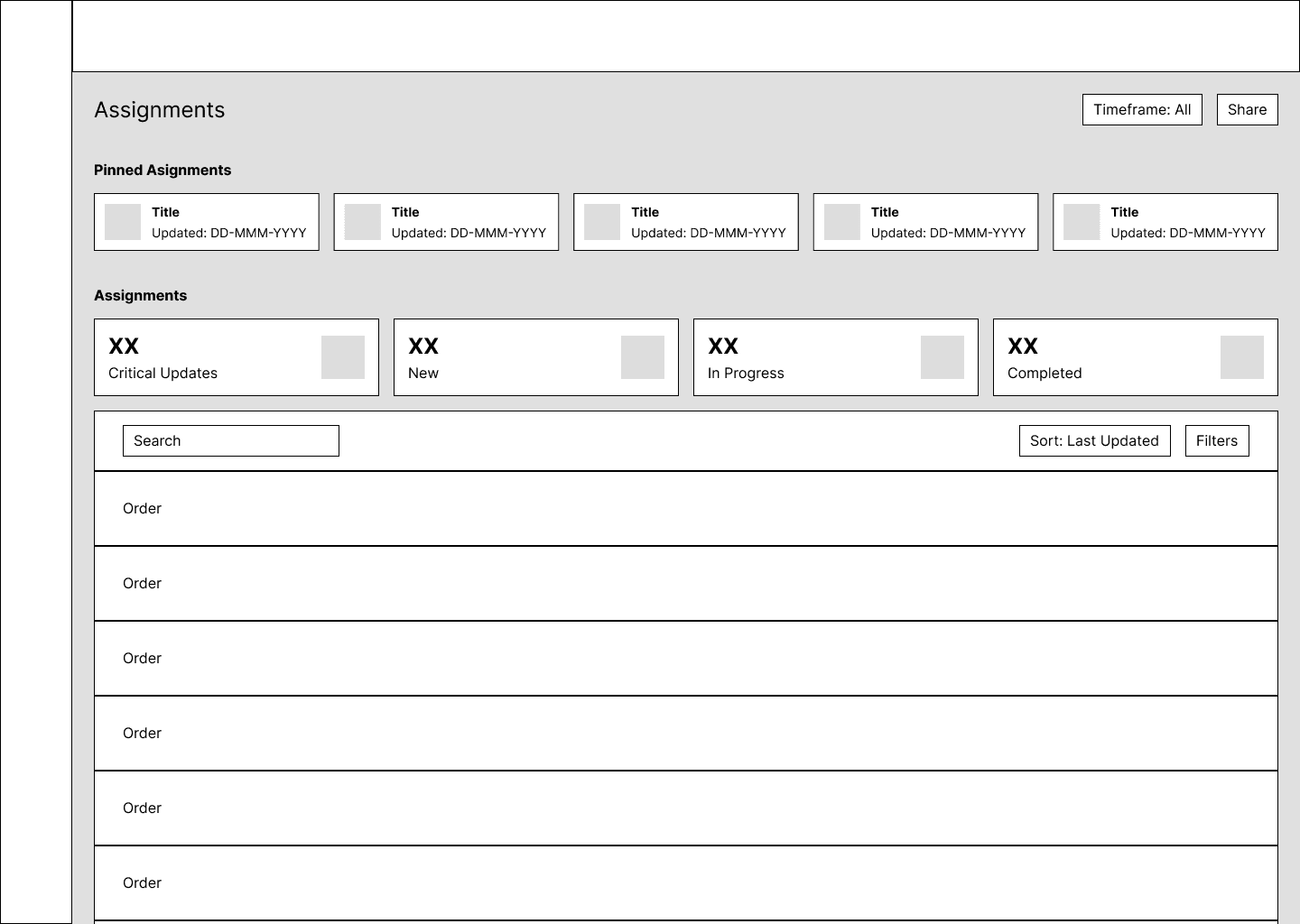
Assignments_Default
2nd iteration

Assignments
Order Selected
The Solution
A modular, IoT-connected B2B platform ecosystem — built on a unified design system and shipped across six product surfaces.
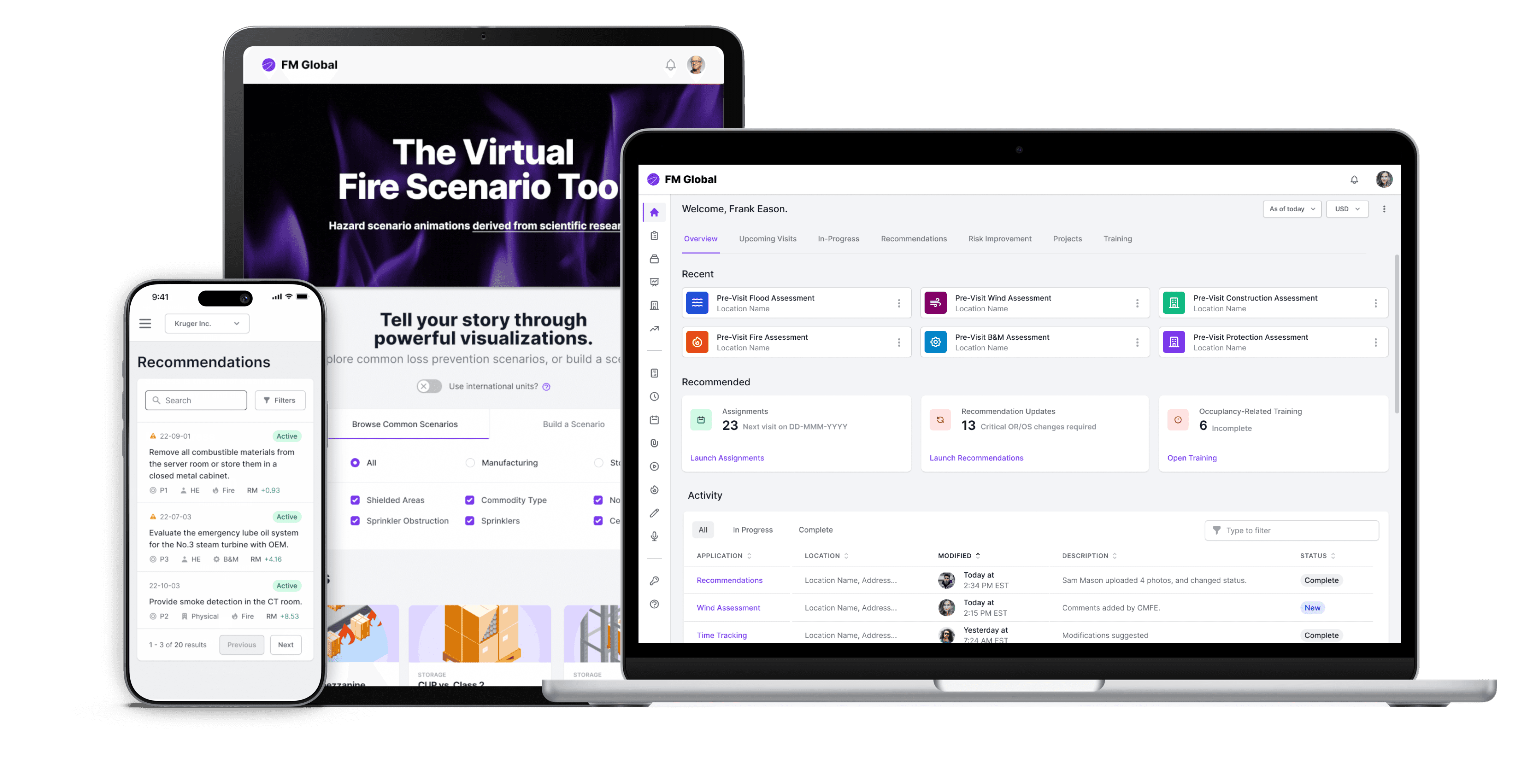
Polaris is a responsive web portal giving FM Global's Field Engineers and clients access to a suite of interconnected apps as individual tabbed dashboards — all built on the Resilience design system that the XD team developed in parallel. Rather than replacing siloed tools one at a time, the solution established a shared platform shell and design language that allowed six distinct product surfaces to feel like one coherent experience.
The central design decision was modularity — a DCE Platform Shell that could house any combination of tools without visual or navigational fragmentation. Every product module, from the Virtual Fire Scenario Tool to Enterprise Risk Insite, was designed to the same system while serving fundamentally different user types and use cases.
Selected Screens — Figma Prototypes
Selected Screens — Final Design Review

Polaris DCE Platform Shell
Portal navigation & order management

Virtual Fire Scenario Tool
Real-time risk simulation & visualization

Climate Change Impact Report
Data visualization dashboard

Enterprise Risk Insite
Risk recommendations & reporting

The Impact
A platform ecosystem — and the design system that made it coherent.
The Polaris engagement delivered validated, prototype-tested designs across four product modules — with QA and UAT completed to ensure the built experience matched design intent. The parallel Resilience design system work established the shared foundation that allowed six product surfaces to feel like one unified platform, replacing a fragmented legacy experience with something designed for coherence from the start.
Client risk-improvement actions enabled platform-wide in 2022
6
IoT technologies and frameworks unified under one design system
2,000+
Loss prevention engineers globally using new DCE tools
Design systems are product work
Building the Resilience system in parallel with the Polaris products wasn't a separate track — it was the strategic design decision that made cross-team coherence possible at scale. Foundations first is not a slower path; it's the faster one.
Coherence requires intentional governance
Applying Digital Brand Standards across six concurrent workstreams meant treating design coherence as an active design responsibility — not something that happens by default when multiple teams share a Figma library.
Client and engineer needs require different design lenses
The Polaris platform served two fundamentally different user types within the same portal. Maintaining that distinction — in information architecture, data density, and interaction model — while preserving visual coherence was the central design tension of the engagement.
QA and UAT close the design-to-product gap
Staying involved through build, QA, and User Acceptance Testing meant the implemented platform reflected the design intent — not just the specifications. That ownership through launch is what made the Resilience system a real foundation rather than a theoretical one.